


What if the rug that makes your room feel complete also works for everyday life? A striking pattern can catch your eye, but choosing designer rugs Australia homes can live with means thinking beyond appearance. Look for a design that suits your furniture, fits the room and works with the way your household uses the space.
Colours can look different on screen, and a product photo can’t show exactly how a rug feels underfoot. Pets, children and busy walkways add practical considerations. The right choice balances personal style with details such as size, material and construction, so it feels at home from the start.
This guide will help you compare styles, materials and construction, plan the rug’s size and placement, and consider the needs of Australian homes, from family living to indoor-outdoor flow. You’ll also find tips for comparing options online. If you’d like help narrowing down colour, style or room fit, Cozy Rugs offers a free design consultation.
Key Takeaways
- Choose designer rugs Australia homes can live with by weighing design, material and construction alongside the room’s everyday use.
- Use colour and pattern to echo your existing furnishings or add a considered contrast that anchors the space.
- Compare wool rugs and flatweave rugs by their feel and profile, then match your choice to the room and household activity.
- Measure the room, mark the rug footprint, check where furniture legs will sit and leave clear routes around it.
- Before buying online, review the listing’s dimensions, material, construction, colour and care guidance, as well as the shipping details.
What makes a designer rug right for your Australian home?
A designer rug isn’t defined by a particular price tier. Look at how its design, material and construction work together, and whether they suit your room and routine. A considered pattern can anchor a furniture arrangement, while a softer texture can make a space feel more welcoming. Colour can also connect details that might otherwise feel separate, such as timber finishes, cushions and wall paint.
Good design and everyday suitability should work together. Look beyond whether a rug catches your eye. Consider where it will sit, how the room is used and the atmosphere you want to create. In a busy family living area, for example, a striking design still needs to work alongside daily activity. In a quieter bedroom, texture and a restful palette might matter more.
Start with the feeling you want the room to have
Before browsing, decide whether you want the rug to blend in or take the lead. For a calm, cohesive look, draw on colours already in your furniture, artwork or wall finishes. To create a focal point, choose a pattern or colour with more contrast, then repeat one of its tones in a smaller room detail. This creates a connection without making everything match.
Think in mood words: relaxed, grounded, bright or cosy. They’re a simple filter when browsing the range of designer rugs Australia shoppers can find, from modern to traditional styles. A clear idea of the room’s feel helps you compare designs on more than first impressions. It also makes it easier to rule out a rug that looks appealing on its own but doesn’t sit comfortably with your existing furnishings.
Look beyond the product photograph
Online images are a useful starting point, but colour and texture can appear different depending on the screen and photograph. A pale neutral may read warmer or cooler in your room, while a textured surface may look flatter on screen. Consider the rug alongside your room’s natural and artificial light, plus nearby finishes such as timber, tiles, upholstery and paint.
For a practical comparison, note the colours and textures already in the space, then look for a rug that complements them or creates a deliberate contrast. Check the product details as well as the image, and use a history and types of carpets and rugs overview for broader context on how rugs differ in materials and construction. Revisit your shortlist in the room’s usual lighting and compare the written descriptions. A guide to buying rugs online in Australia can also help you know what details to review before choosing.
How do material, texture and construction shape a designer rug?
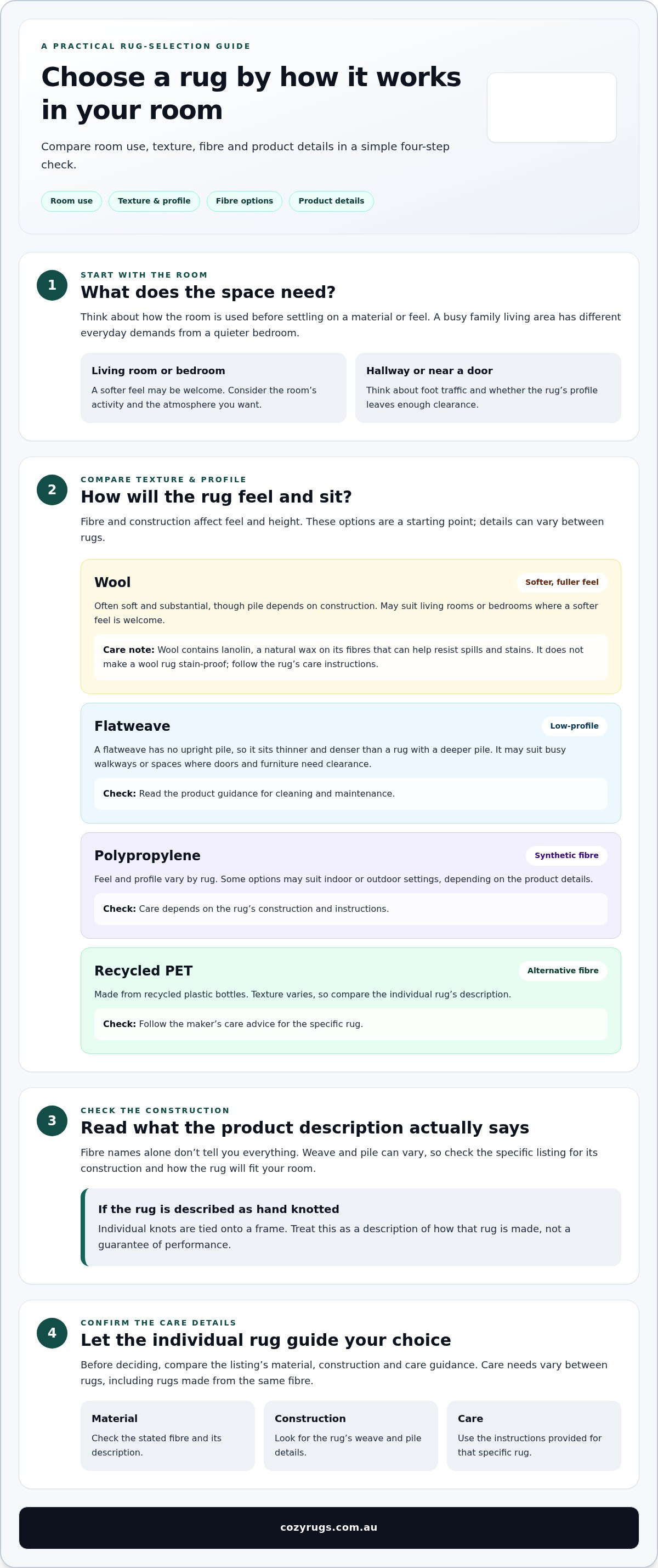
A rug’s fibre and construction affect how it feels underfoot, how much height it adds and how it fits into a room. A wool rug may feel soft and substantial, while a flatweave sits closer to the floor. Neither is automatically the right choice for every home. When comparing designer rugs Australia shoppers can choose from, consider the room’s use, furniture and care needs. Check the specific product details rather than relying on a material name alone.
Use this comparison as a starting point. Fibre, weave and pile can vary between rugs, so refer to each listing for its exact construction and care advice.
| Option | Texture and profile | Care considerations | May suit |
|---|---|---|---|
| Wool | Often soft with a fuller feel; pile depends on construction | Follow the rug’s care instructions and attend to spills as directed | Living rooms or bedrooms where a softer feel is welcome |
| Flatweave | Low-profile, with no upright pile | Check the product guidance for cleaning and maintenance | Busy walkways or spaces where doors and furniture need clearance |
| Polypropylene | Synthetic fibre; feel and profile vary by rug | Care depends on the rug’s construction and instructions | Some indoor or outdoor settings, depending on product details |
| Recycled PET | Made from recycled plastic bottles; texture varies | Check the maker’s care advice for the specific rug | Shoppers comparing alternative fibre options |
Match texture and pile to the way you use the room
A flatweave has no upright pile, giving it a thinner, denser profile than a rug with a deeper pile. That can make it worth considering in a hallway or near a door, where clearance matters. In a living area, think about whether chairs can slide easily and furniture sits evenly. For a family space, consider everyday movement through the room, not just how the rug looks in a styled photo.
Compare natural and synthetic fibres without overgeneralising
Wool contains lanolin, a natural wax on its fibres that can help resist spills and stains, but it doesn’t make a wool rug stain-proof. Care requirements still depend on the rug itself. Polypropylene and recycled PET are other fibre options found in rugs generally, but their feel and care guidance vary by construction. If you’re weighing wool’s qualities, explore wool rugs at Cozy Rugs and read each listing’s material and care details.
Construction matters, too. If a product description says a rug is hand knotted, that means individual knots are tied onto a frame. Treat the term as a description of how that rug is made, not a guarantee of performance. Check the listing for construction details, then weigh them against the room’s needs. This helps you choose a rug that feels right underfoot and suits the way you live.
Which designer rug style works with your furniture and lifestyle?
A rug should relate to the furniture you already own, but it doesn’t have to match every piece. Start by identifying the room’s strongest feature, perhaps a timber dining table, a coloured sofa or artwork you love. Then decide whether the rug should support that feature or bring in a new point of interest. Designer rugs Australia homes can draw on include modern, traditional and natural styles. Compare how each design sits with your furnishings, rather than choosing by its style label alone.
Room use matters as much as appearance. A rug in a quiet sitting room has different demands from one in a family living area where people, pets and guests regularly pass through. Think about how the space works on an ordinary day, then narrow your design choices to suit.
Choose between a quiet foundation and a statement design
A neutral or natural-looking design can sit quietly beneath layered furnishings and make it easier to change cushions, throws or artwork over time. It can suit a room where the furniture already has strong colour or detail. A patterned rug, by contrast, can become the room’s focal point, especially among simpler furnishings. To help a bold pattern feel connected, repeat one or two of its colours in nearby cushions, a throw or artwork.
Traditional designs can bring detail and visual history to a room, while modern patterns may suit interiors with cleaner lines. Natural colours and textures can complement timber, woven pieces and relaxed furnishings. These are starting points, not rules. A traditional pattern can work in a contemporary room, for example, if its colours relate to the furniture and finishes around it.
Make the design work for pets, family life and entertaining
Before choosing a plush texture or pale colour, consider the likelihood of crumbs, muddy paws, spills and regular foot traffic. A pattern may make everyday marks less noticeable than a plain surface, but care depends on the rug’s material and construction, so read the product guidance. If a rug will sit near an entry or dining table, think about how often the area is used and how you’ll manage routine cleaning.
Australian homes often connect indoor rooms with patios, decks or other outdoor areas. That lifestyle can influence your colour and styling choices, but it doesn’t mean every rug is made for outdoor use. Check the product description for its intended setting and care details before placing it outside or in an exposed area.
For a balanced result, look at the rug alongside the sofa, chairs and other large pieces. Decide whether its pattern and colour support the room or compete with it. Room dimensions and furniture placement also affect the overall look, so use a rug size guide when you’re ready to plan the layout. To compare different looks, browse modern and traditional rugs and consider which style feels most at home with your furnishings.
How do you choose the right designer rug size and placement?
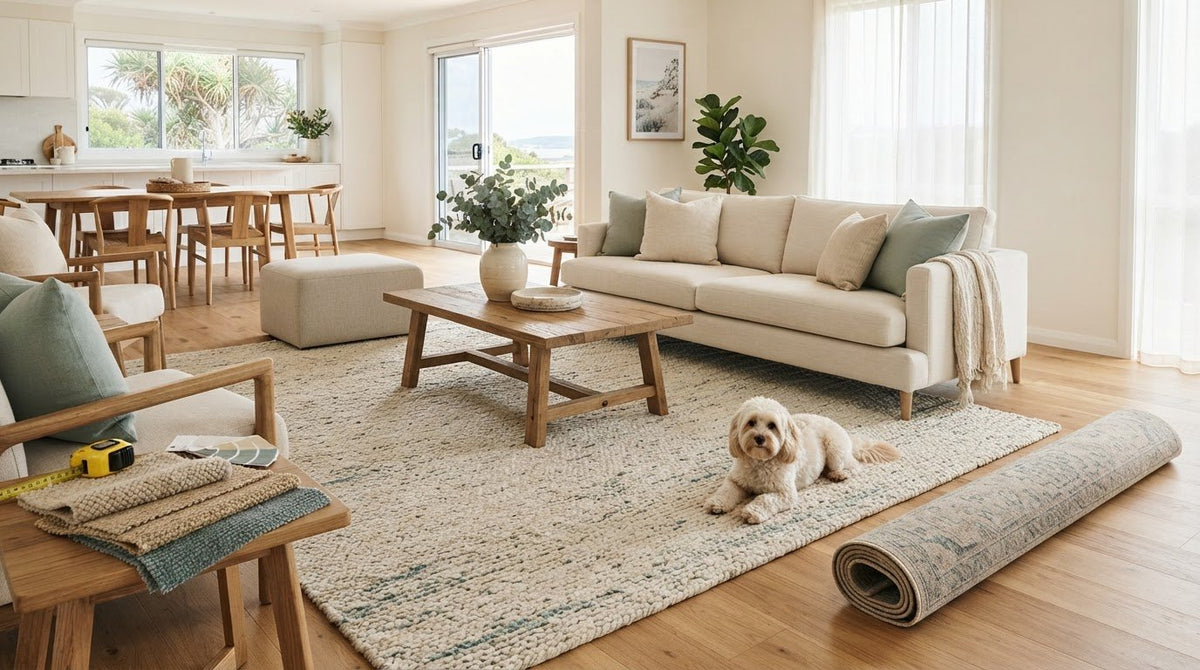
The right rug can group furniture with purpose, while the wrong scale may leave a seating area looking disconnected or crowd the open floor. Before settling on a design, test how its footprint will work in your room. Measure first, so you choose a rug design that fits the space and the way you use it. This is a useful starting point for comparing designer rugs Australia homes can make their own.
Measure the room before settling on a design
Use this four-step process to check the footprint before you buy:
- Measure the room: Note the available floor area, including boundaries created by walls, built-in features and nearby furniture.
- Mark the footprint: Use painter’s tape or another removable marker to outline possible rug dimensions on the floor. Step back and view the shape from the main entrance and seating area.
- Check furniture legs: Decide whether the rug will sit beneath all the main furniture legs, just the front legs, or in front of the furniture. Mark the layout so you can see how the rug relates to the sofa, chairs or bed.
- Reassess circulation: Walk around the marked area. Check door swings, clear routes between rooms, chair movement and access to frequently used furniture.
This quick mock-up often reveals details a room photo can hide. A rug that looks ample online may leave key furniture outside its boundary, while a larger footprint could make a seating zone feel more connected. There’s no single layout for every room, so use the rug size guide for detailed room-specific measurements rather than relying on a general rule.
Plan placement around the furniture layout
In a living room, one option is to place the rug under the front legs of the sofa and chairs. This can visually bring the seating together while leaving some floor visible around the group. A larger rug may sit beneath all the main seating, creating a more unified area. In a compact room, a rug placed in front of the furniture can still define the zone, provided it looks intentional and doesn’t interrupt the path through the space.
In an open-plan home, use rug placement to give a living or dining area a clear centre without blocking the natural route between zones. Keep the rug aligned with the furniture arrangement, and leave enough room for chairs to move as intended. In bedrooms, consider how the rug relates to the bed and where you step when getting up. These checks help balance furniture with open floor, rather than choosing a design first and trying to make it fit afterwards.
Once you’ve marked out a footprint that suits the room, browse rugs by size and style to compare options against your planned layout.
Where can you find designer rugs in Australia with helpful guidance?
Shopping online gives you room to compare styles at your own pace. Product listings are most useful when they answer practical questions as well as showing an appealing design. As you browse designer rugs Australia shoppers can explore at Cozy Rugs, use the filters to narrow options by size, colour and pattern. Compare a shortlist against your room measurements and notes, rather than relying on one striking image.
Use product details and design support to narrow your shortlist
Compare each option using the same checklist. This makes it easier to assess rugs side by side, even when their photographs look similar:
- Dimensions: Check that the listed measurements suit the footprint you’ve planned.
- Material: Read the fibre details and consider the room’s routine.
- Construction: Look for product-specific information about how the rug is made.
- Colour and pattern: Compare the description with the finishes and furnishings in your space.
- Care guidance: Note the recommended upkeep before making your final choice.
Keep a short note for each option with its key details and what appeals to you. This makes it easier to spot meaningful differences and return to your preferred choices without relying on memory. If you’re comparing several rugs, save or write down the listing details alongside your room measurements, then review the options together.
Cozy Rugs brings its rug selection together online for Australian shoppers, with options to browse by size, colour and pattern. Product information helps you understand the rug you’re considering, while comparing the listing with your room notes keeps your decision grounded in the space it needs to suit. A thoughtful shortlist is often more useful than browsing endlessly, especially when you’re weighing colour, pattern and practical fit. If you’d like help comparing options, you can also use the free design consultation.
Explore designer rug styles available across Australia
Cozy Rugs offers modern, natural and traditional styles, as well as the Darren Palmer Collection. Use these categories as a first step, then look closely at individual rug descriptions to find the colour, pattern and feel that best suits your home. This keeps the choice personal without relying on a style label alone.
Ready to see what might work in your space? Explore designer rugs at Cozy Rugs and take the time to find a design that feels right for your home.
Take the next step towards a room that feels like yours
A good choice from the designer rugs Australia offers should feel connected to your home, not chosen for a trend alone. Picture how the rug will live with your furniture and the rhythms of your household. The aim isn’t to make every detail match. It’s to choose a piece that feels at ease in the room now and leaves room to refresh smaller touches later.
If you’re still weighing up your options, a little guidance can help turn a shortlist into a clear choice. Consider the colours and details you’re drawn to, then trust your sense of what will make the space welcoming and comfortable for everyday life.
Explore designer rugs and find a style for your home. Browse the available designs, or book a free design consultation to get help choosing a rug for your space.
Frequently Asked Questions
What is a designer rug?
A designer rug is generally presented with a considered visual design, but the term alone doesn’t tell you how it was made. It doesn’t automatically mean a particular fibre, weave, origin or handmade method. Treat the label as a prompt to inspect the individual rug’s description and construction details, rather than as a technical grade. That distinction helps you compare products using details you can actually assess.
Are designer rugs suitable for homes with pets and children?
They can be, provided the rug’s surface and care needs suit your household. If your pet has claws, look closely at the pile and weave, as some textures may catch more easily than others. Consider where pets tend to rest, too: a rug in a favourite spot may need more frequent attention than one in a quieter part of the room. Use the care guidance to plan for your routine.
How do I choose a designer rug colour for my living room?
Start with the room’s largest fixed surface, often the flooring, and decide whether you want the rug to stand apart from it or sit closer in tone. A clear difference can make the rug’s outline easier to see, while a closer tone can create a more subtle transition. If you’re deciding between two shades, compare them against the floor rather than judging each colour on its own.
What materials are commonly used in designer rugs?
Common rug materials include wool, cotton and plant-based fibres, as well as synthetics such as polypropylene and polyester. Some rugs use a blend, so the label may name more than one fibre. Check whether a description refers to the pile, backing or the whole rug, as these parts can use different materials. Fibre names describe composition, but don’t by themselves tell you the full feel or finish.
Can I use a designer rug in an open-plan Australian home?
Yes. An open-plan space gives you a chance to consider how a rug looks from several viewpoints, including the kitchen or dining area, not just from the sofa. Check that its pattern and colours feel comfortable from each angle, and that the rug doesn’t create an abrupt visual stop between connected spaces. This broader view can help the whole room feel considered without relying on matching furnishings.
How do I care for a designer rug?
Follow the care instructions for your specific rug, and avoid applying a cleaning product until you know it’s suitable for that material. For a fresh spill, use the method stated in the product guidance rather than rubbing or scrubbing by instinct. If the instructions allow, rotating the rug occasionally can change which areas receive the most foot traffic. Keep the care details handy so you can refer to them when needed.
Does Cozy Rugs ship designer rugs across Australia?
Yes, Cozy Rugs ships designer rugs across Australia. Before placing an order, review the delivery information for your destination and keep your order details for reference. It’s also useful to confirm that you’ve selected the intended rug and size, particularly if you’ve compared several options. That small final check helps ensure the item you order is the one you planned for your home.


Leave a comment
This site is protected by hCaptcha and the hCaptcha Privacy Policy and Terms of Service apply.