


Why do we invest so much in styling our homes only to let the very first impression feel like a cold, echoing wind tunnel? If you've ever winced at the sound of heavy footsteps on floorboards or felt a sharp chill underfoot during a brisk morning, you're definitely not alone. Most Australian homeowners find that their corridors are the hardest-working zones in the house, yet they're often the most neglected. Integrating a high-quality wool hallway runner is the most effective way to dampen noise and add immediate warmth to your entrance.
We believe that your hallway should be as stylish as it is functional. This guide will help you discover why wool is the premier choice for busy thoroughfares and how to select a piece that handles the daily chaos of pets and kids with ease. We'll walk you through the essentials of measuring your space correctly, choosing the right pile for durability, and finding a design that reflects your personal style. By the end, you'll know exactly how to create a quiet, comfortable, and beautiful transition that welcomes you home every single day.
Key Takeaways
- Learn why wool’s natural resilience makes it the "gold standard" for durability in the busiest parts of your home.
- Understand the difference between flatweave and plush pile to ensure your rug doesn't interfere with door clearance.
- Find out how to select the perfect wool hallway runner width and length to create a beautiful "framing" effect on your floors.
- Pick the right "Modern Australian" colours and patterns that naturally hide everyday dust and heavy foot traffic marks.
- Master simple care routines, including the correct way to vacuum, to keep your natural fibres looking fresh for years to come.
Why Wool is the Gold Standard for Australian Hallway Runners
Think of a wool hallway runner as more than just a piece of decor; it's a high-performance natural fibre solution designed for the specific demands of Australian corridors. Our homes often face extreme temperature swings, and wool acts as a natural insulator. It helps trap heat during a chilly Melbourne winter while remaining breathable enough to stay cool during a Perth summer heatwave. Because of its unique structure, wool has long been considered the Gold Standard for hallway runners and carpets globally.
Beyond temperature control, the most impressive feature of wool is its natural resilience. Unlike synthetic materials that tend to flatten and lose their shape over time, wool fibres have an incredible ability to bounce back. This ensures your runner stays looking plush and inviting, even after years of heavy footfall from a busy family. It's a reliable choice that balances domestic harmony with rugged durability.
The Science of Durability: Lanolin and Elasticity
Lanolin is wool's secret weapon. This natural wax coats the fibres, acting as a built-in barrier that repels liquids and prevents spills from soaking in immediately. It gives you those precious few moments to grab a cloth and blot away a mess before it becomes a permanent stain. For many Aussie households, this makes a wool hallway runner far more practical than it might first appear.
Each wool fibre also features a microscopic "crimp" that works like a tiny spring. When you walk across the rug, the fibres compress and then pop back into place. This elasticity is exactly why wool outperforms synthetic alternatives in high-traffic "pinch points," such as the narrow space between the front door and the living room. It simply refuses to stay matted down.
Acoustic Comfort in Modern Aussie Homes
Modern Australian homes often favour open-plan layouts and hard flooring like timber, laminate, or tiles. While these surfaces look sleek, they're notorious for creating echoes and amplifying the sound of every footstep. A thick wool runner effectively absorbs these sound waves. It turns a noisy, clattering corridor into a peaceful transition zone where conversations don't bounce off the walls.
For households with energetic kids or pets, this acoustic dampening provides a "soft landing." It mutes the sound of running paws and heavy school shoes, bringing a sense of calm to the morning rush. Investing in wool isn't just about the look; it's about making your home a quieter, more comfortable place to live.
Flatweave vs. Plush Pile: Which Wool Runner Suits Your Corridor?
Choosing the right texture for your wool hallway runner is a bit like picking the right shoes for a long walk. It needs to look great, but it also has to suit the terrain. In many Australian homes, the terrain includes high-traffic zones and doorways that don't leave much room for error. You'll generally be deciding between a low-profile flatweave or a thicker, plush pile rug. Each has its own strengths depending on your home's layout and your family's lifestyle.
Understanding the construction is key. Hand-tufted rugs are created by punching yarn through a backing, resulting in a soft, cushioned feel. Hand-knotted runners are crafted by tying individual knots to a frame, which often makes them more resilient over decades. Both provide the natural benefits of wool, but the height of the pile will dictate how the rug functions in your specific corridor.
Wool Flatweave Runners: The Minimalist Workhorse
Flatweaves are the ultimate choice for busy households. Because they have no upright pile, they are incredibly thin and dense. This is a practical lifesaver if you live in an older home where the front door sits low to the floorboards. A thick rug would catch every time the door opens, but a flatweave glides right under. Many flatweave rugs are also reversible. You can flip them over to even out the wear from heavy foot traffic, which significantly extends the life of the piece. They are also the best option for pet owners, as claws are less likely to snag on the tight weave.
Plush and Tufted Wool: Adding Luxury to the Entryway
If your hallway is wide and your doors have plenty of clearance, a plush wool runner adds an immediate sense of luxury. A higher pile offers superior acoustic dampening and a soft feel underfoot that synthetic rugs simply can't match. You might notice some minor shedding during the first few weeks. This is a natural characteristic of new wool and isn't a sign of poor quality. Regular vacuuming quickly settles the fibres.
Beyond the comfort, choosing a natural fibre has health benefits. Research by The Woolmark Company highlights how wool's structure assists with Durability and Care by absorbing indoor pollutants and improving air quality. If you're ready to elevate your entrance, you might like to browse our latest wool runner styles to see which texture speaks to you.
The Perfect Fit: How to Measure and Place Your Runner
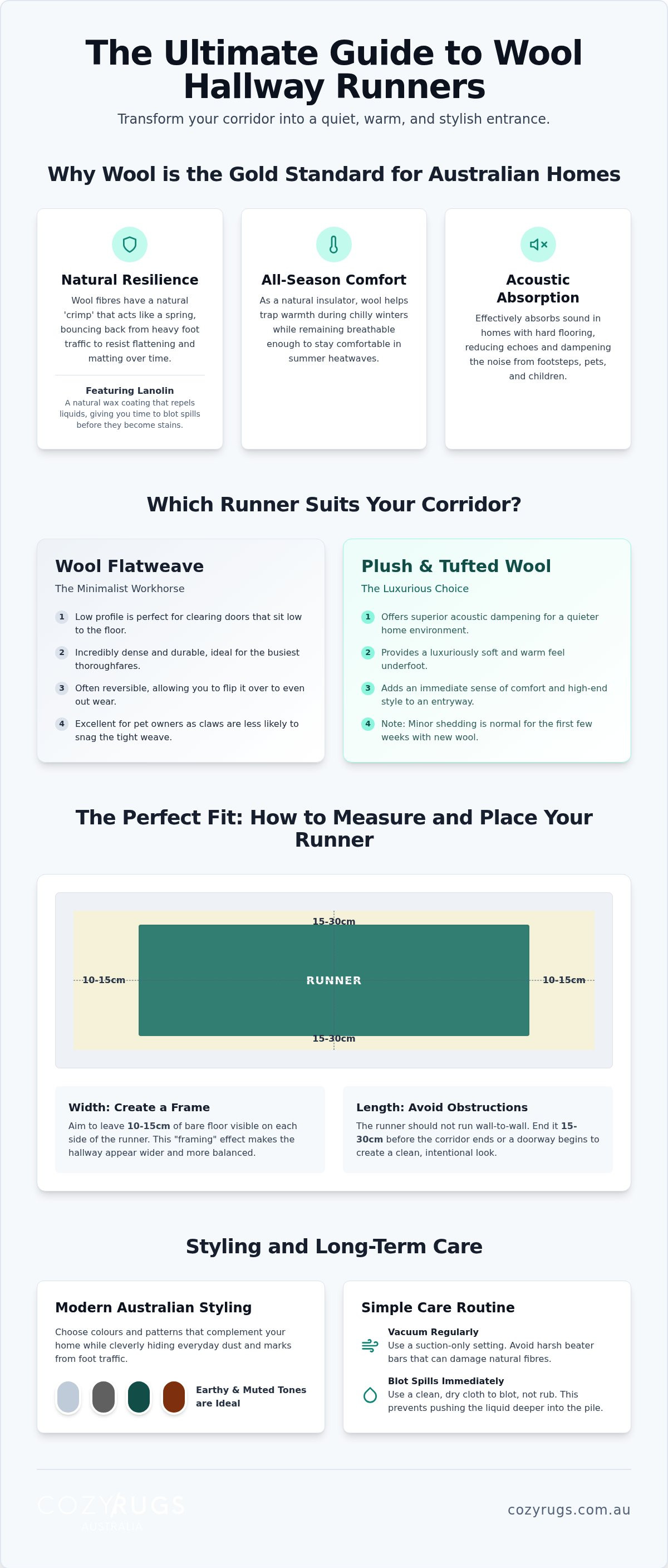
Getting the measurements right is the difference between a hallway that looks professionally styled and one that feels a bit cramped. When you place a rug in a corridor, you're aiming for a "framing" effect. This means you should always leave a visible border of your original flooring around the edges of the rug. This gap prevents the space from looking cluttered and actually makes a narrow hallway feel wider and more balanced. Think of your floorboards or tiles as the matte border around a beautiful piece of art.
In most modern Australian homes, hallway widths typically range between 90cm and 120cm. To achieve that ideal frame, you'll want to choose a runner width that leaves at least 10cm of floor visible on either side. A standard 80cm wide runner is a versatile choice for many traditional builds, while wider 100cm options are fantastic for grander entrances or newer homes with more generous proportions. If you have a console table, it's usually best to keep all four legs off the runner entirely to ensure the furniture stays level and the rug remains the unobstructed centrepiece.
Very long hallways often present a unique dilemma: should you go with one continuous runner or two shorter ones? A single, long runner creates a grand, unbroken line that draws the eye forward. However, if your hallway is exceptionally long or has a turn, using two separate rugs can break up the visual "tunnel" and allow for more flexibility. Just ensure the gap between the two rugs is consistent, usually around 10cm to 15cm, to maintain a cohesive look.
Step-by-Step Measurement Guide
To find your ideal length, measure the total distance of your hallway and subtract about 40cm to 60cm. This allows for a 20cm to 30cm gap at each end, ensuring the rug doesn't look like it's jammed against the skirting boards. For the width, measure the narrowest point of the corridor. Always measure twice to ensure your wool hallway runner centres perfectly. If you're unsure about the length, laying down some painter's tape on the floor can help you visualise the final result before you commit.
Placement and Safety: The Role of Underlay
Safety is just as important as style, especially on slick timber or tiled surfaces. A high-quality, non-slip underlay is essential for any wool hallway runner. It keeps the rug firmly in place, preventing it from bunching up or sliding when the kids or pets go for a dash. Beyond safety, an underlay acts as a protective buffer. It reduces the friction between the rug's backing and your hard floors, which helps prevent scratches and stops the underside of your wool fibres from wearing down prematurely. For the best results, trim the underlay so it sits about 2cm inside the edge of the rug to keep it completely hidden.
Styling Your Entryway: Colours and Patterns for High-Traffic Zones
Your hallway sets the stage for the rest of your home. It's the first thing guests see and the last thing you experience before heading out the door. Choosing a wool hallway runner that looks beautiful while standing up to the "track marks" of daily life is a clever design move. In the past, many felt limited to dark, heavy colours to hide dirt, but modern design has opened up a much more exciting palette.
We're seeing a big shift towards the "Modern Australian" aesthetic. This style embraces warm neutrals, soft greys, and earthy tones like sand, clay, and camel. These colours reflect our natural landscape and make an entrance feel bright and airy. To ensure your hallway feels cohesive, consider how the runner's style complements your existing wool rugs australia decor in the connecting rooms. A consistent colour story helps the whole house feel like one organised, peaceful space.
Pattern Power: Hiding the Hustle and Bustle
If you have a busy household with kids or pets, patterns are your best friend. Speckled or "heathered" wool yarns, which use a blend of slightly different coloured fibres, are incredibly forgiving. They naturally camouflage dust, lint, and the occasional stray crumb. For those with a shorter corridor, a striped runner can work wonders by visually elongating the floor. If you prefer a more "modern heirloom" look, traditional Turkish patterns with a faded or distressed finish add character without being overwhelming. These intricate designs are masters at hiding everyday wear while adding a sophisticated layer to your home.
The Designer Touch: The Darren Palmer Collection
For homeowners wanting a truly polished look, designer-led choices like the Darren Palmer collection offer a sophisticated take on the Australian lifestyle. These pieces often feature subtle textures and refined neutral tones that look high-end but are built for real life. You don't have to sacrifice durability for a high-fashion look. By choosing a designer runner, you can easily match the aesthetic of other natural rugs australia throughout your living areas. This creates a seamless flow from the moment you step inside, making your home feel curated and thoughtfully put together.
Ready to give your entrance the upgrade it deserves? You can shop our wool runner collection today to find the perfect blend of style and durability for your home.
Durability and Care: Making Your Wool Runner Last a Lifetime
Is wool too hard to look after? It's a question we hear a lot, but the reality might surprise you. Many people worry that a wool hallway runner will be a magnet for stains and require constant attention. In truth, wool is one of the most forgiving materials you can choose for a high-traffic zone. Because of the natural lanolin coating each fibre, it actually resists dirt and liquids far better than most synthetic alternatives. It's a rugged, practical choice that doesn't demand a PhD in cleaning to maintain.
The most important part of your care routine is regular vacuuming. Aim for once or twice a week to keep dust from settling deep into the pile. However, you must use a suction-only setting. Avoid using a power head or beater bar. These can agitate the fibres and lead to pilling or "fuzzing" over time. If a spill does happen, keep your cool. Grab a clean, dry cloth and blot the area firmly. Never rub the stain. Rubbing pushes the liquid deeper and can permanently damage the delicate fibre structure. For a deep refresh, a professional steam clean every 12 to 18 months is a great investment to keep the colours vibrant and the fibres healthy.
The Pet-Owner’s Secret Weapon
If you have four-legged family members, you'll be glad to know that pet friendly wool rugs are a genuine game-changer. Wool is naturally odour-resistant, which helps keep that "doggy smell" at bay even in an enclosed corridor. It's also a safer choice for your pets. Unlike some synthetic rugs that can off-gas volatile organic compounds, wool is a natural, non-toxic material. To manage shed fur, a specialized rubber rake or a stiff upholstery brush works wonders on different wool piles. It's a simple way to keep your entrance looking sharp and smelling fresh without using harsh chemicals.
Rotating for Even Wear
Hallways are unique because the foot traffic usually follows a very specific line right down the centre. To prevent "traffic lanes" from forming, try to rotate your runner 180 degrees every six months. This simple habit balances out the wear and ensures that any sun exposure from nearby front doors or windows is distributed evenly. It keeps the colours consistent and stops one end from looking more "loved" than the other. A well-cared-for wool runner can easily last a decade or more in a busy Australian home. It's a sustainable, long-term investment that grows with your family.
Transform Your Entrance into a Quiet, Stylish Sanctuary
Your hallway doesn't have to be a noisy or cold transition space. By choosing a high-quality wool hallway runner, you're investing in a natural fibre that balances rugged durability with a warm, welcoming feel. Remember to leave that essential 10cm floor border for a balanced look and always use a non-slip underlay to protect both your rug and your family. These small details ensure your entrance remains safe and sophisticated for years to come.
Whether you're drawn to the minimalist appeal of a flatweave or the designer touch of the Darren Palmer collection, we're here to help you get the fit exactly right. We offer a Free Design Consultation to take the guesswork out of measuring, and with Australia-Wide Shipping, your new runner is only a few clicks away. It's time to stop settling for a bare corridor and start enjoying a home that feels complete from the moment you step through the door.
Browse our curated collection of Wool Hallway Runners and find the perfect durable natural fibres for your home. We can't wait to help you make a beautiful first impression.
Frequently Asked Questions
Are wool hallway runners good for high-traffic areas?
Yes, wool is exceptionally well-suited for high-traffic zones. Its natural elasticity allows the fibres to spring back after being stepped on, preventing the flat, matted look common with synthetic alternatives. Additionally, the natural lanolin acts as a protective shield against dirt. This makes a wool hallway runner a durable, long-term investment for busy Aussie homes. It handles the daily hustle of kids and pets while maintaining its plush appearance for years.
How long should a hallway runner be?
Your runner should ideally cover the majority of the hallway while leaving a 20cm to 30cm gap at each end. This framing effect ensures the rug doesn't look like it's jammed against the skirting boards. If your corridor is exceptionally long, you might consider using two shorter runners with a small, consistent gap between them. This approach breaks up the visual tunnel and can be easier to handle during cleaning.
Should a hallway runner be the same colour as other rugs in the house?
It's not necessary for every rug to be identical, but they should share a similar colour story or aesthetic. For example, if your living room has earthy tones, a runner in a soft clay or sand hue will create a seamless flow. This connection makes your home feel thoughtfully organised rather than disjointed. You can experiment with different patterns in the hallway to hide dirt while keeping the base colours consistent.
How do I stop my wool hallway runner from slipping?
A high-quality, non-slip underlay is the most effective solution. It provides essential grip on slick surfaces like timber, laminate, or tiles, ensuring the rug stays firmly in place. This isn't just about safety; an underlay also acts as a cushion that reduces friction between the rug's backing and your hard floors. By preventing the rug from bunching or sliding, you're protecting the delicate fibres and significantly extending the lifespan of your investment.
Is wool or jute better for a hallway runner?
Wool is generally the superior choice for comfort and longevity. While jute offers a lovely organic texture, it can be quite rough underfoot and is much harder to clean if a spill occurs. Wool's natural lanolin makes it inherently stain-resistant and much softer for bare feet. If you're looking for a rug that combines durability with a touch of luxury, wool outperforms jute in almost every high-traffic scenario within a busy Australian home.
How do you clean a wool runner rug?
Regular maintenance involves vacuuming once or twice a week using a suction-only setting. It's crucial to avoid beater bars as they can fray the natural fibres. For spills, always use the blot, don't rub method with a clean, dry cloth to lift the liquid. If your rug needs a deeper refresh, we recommend a professional steam clean every 12 to 18 months to remove deeply embedded dust and keep the colours looking fresh.
Do wool runners shed a lot?
It's perfectly normal for a new wool hallway runner to shed small amounts of fibre during the first few weeks. This is simply a characteristic of natural wool and isn't a sign of poor quality. Most of this fuzz will disappear after a few regular vacuuming sessions. Higher-quality wools and tighter weaves tend to settle much faster than cheaper, loosely woven alternatives that you might find in big-box retail stores.
What is the standard width for a hallway runner in Australia?
In Australia, the most common standard width for a runner is 80cm. This size fits comfortably in most traditional corridors while leaving a 10cm to 15cm border of flooring visible on either side. For modern builds with wider hallways, a 100cm wide option is often a better fit to maintain the correct proportions. Always measure the narrowest point of your hallway to ensure you have enough space for that essential framing effect.


Leave a comment
This site is protected by hCaptcha and the hCaptcha Privacy Policy and Terms of Service apply.