


Why do we spend thousands on "forever" flooring only to cover it with a synthetic rug that looks crushed and tired within twelve months? It's a common frustration for many Australian homeowners who find themselves dealing with the constant echo of footsteps on timber or the biting chill of tiles underfoot during winter. You likely want a home that feels peaceful and looks polished, but these high-traffic "highways" are notoriously difficult to style without sacrificing long-term durability.
We agree that your hallway deserves more than a temporary fix that flattens under pressure. Understanding the specific wool hallway runner benefits is the first step toward transforming these transit zones into comfortable, quiet, and sustainable spaces that actually look better as they age. A quality wool runner acts as a natural insulator and a high-performance filter for your home's busiest path, providing a soft landing that synthetic fibres simply can't match.
This 2026 guide will show you why wool remains the gold standard for Australian interiors. We'll help you discover how to choose the perfect texture and size to improve your home's acoustics while ensuring your investment stands up to the rigours of daily family life for years to come.
Key Takeaways
- Learn why wool's natural fibre "crimp" makes it the most resilient choice for the high-traffic "highway" of your home.
- Discover the practical wool hallway runner benefits, including natural stain resistance and improved indoor air quality for your family.
- Understand the "cost per year" logic to see how a premium wool investment saves you money over recurring synthetic replacements.
- Master the professional "10cm rule" for measuring borders and learn how to select the right pile height for easy door clearance.
- Explore how designer-led options like the Darren Palmer collection can bring a sophisticated, high-end finish to your home's interior.
The Hallway Challenge: Why Wool is the Natural Solution for Australian Homes
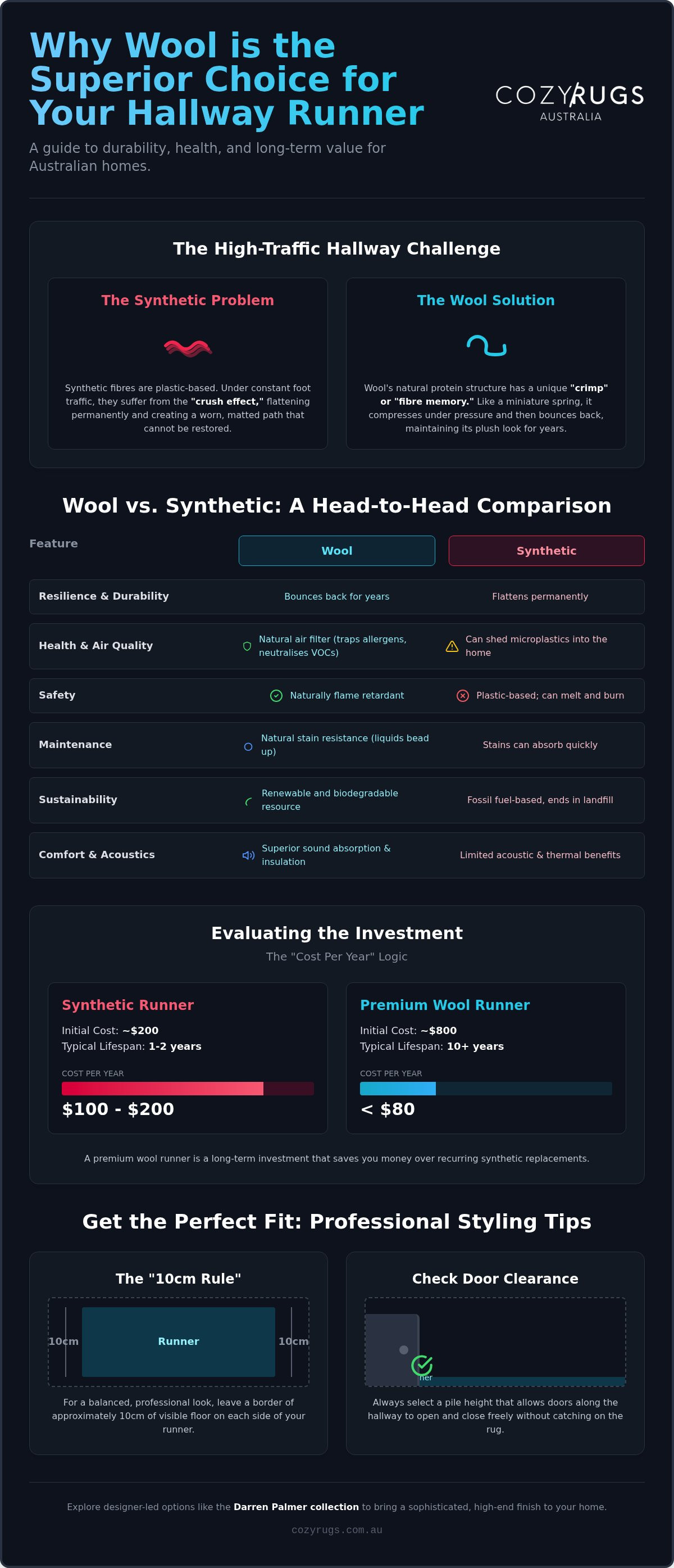
Think of your hallway as the spine of your home. It’s the central artery that connects your living spaces, bedrooms, and entrance, meaning it endures the highest foot traffic per square metre of any floor surface you own. Because of this constant use, choosing the right material isn't just about style; it's about structural integrity. A wool hallway runner is a long, narrow textile floor covering made from natural sheep's wool, designed specifically to provide durability and comfort in these high-traffic zones.
While synthetic alternatives like polyester or nylon might look decent on the shelf, they often succumb to the "crush" effect within just a few months of heavy use. In a narrow corridor, footsteps fall in the exact same spot every single day. Synthetic fibres are essentially plastic, and once they are flattened by repeated pressure, they stay flat. This leads to a worn, matted path down the centre of your rug that no amount of vacuuming can fix.
The Physics of the Hallway: Why Resilience Matters
One of the primary wool hallway runner benefits is the unique physical structure of the fibre itself. Wool is a protein-based fibre with a natural "crimp" that acts like a miniature spring. When you step on it, the fibre compresses, but as soon as you lift your foot, it bounces back to its original height. Fibre memory is the ability of wool to return to its original shape after being compressed. This natural resilience ensures your runner looks plush and premium for years, rather than months. It effectively resists the "tracking" look that ruins the aesthetic of cheaper, man-made rugs.
Acoustics and Insulation in the Modern Australian Home
Beyond the physical durability, wool solves two of the most common complaints in Australian households: noise and temperature. Many of our homes feature beautiful timber or tiled floors that, while stylish, can create a clinical and noisy environment. A thick wool runner acts as a high-performance acoustic dampener, catching and absorbing the "click-clack" of heels or the thundering of kids running down the hall.
Thermal regulation is another area where wool shines. It’s a natural insulator that helps keep your home warmer in the winter by preventing heat loss through the floor, yet its breathable nature ensures it doesn't feel stifling during a hot Aussie summer. By adding a wool runner, you aren't just protecting your floors; you're transforming the entire "feel" of your home from a series of echoing corridors into a warm, cosy sanctuary.
The Core Benefits: Why Wool Hallway Runners Outperform Synthetic Alternatives
Choosing a floor covering isn't just about how it looks on day one; it's about how it serves your household over a decade. One of the most significant wool hallway runner benefits is its status as a truly sustainable choice. Unlike synthetic rugs that shed microplastics into your environment and eventually end up in landfill, wool is a renewable and biodegradable resource. If safety is a priority, you'll also appreciate that wool is naturally flame retardant. It’s difficult to ignite and often self-extinguishes, providing a layer of security that plastic-based fibres simply can't offer.
Hypoallergenic Properties and Air Quality
Your hallway often acts like a wind tunnel, moving air through the rest of the house. Wool fibres act as a natural air filter by trapping common household dust and allergens within the pile. Instead of these particles floating around for your family to breathe, they are held securely until you're ready to vacuum them away. This makes it a superior choice for families living with asthma or allergies. Even more impressive is wool's ability to neutralise Volatile Organic Compounds (VOCs). These chemicals, often found in modern furniture and paints, are absorbed by the wool, which helps keep your indoor air cleaner and healthier.
Natural Stain Resistance and Maintenance
Many people worry that a natural fibre will be hard to clean, but the opposite is usually true. Each wool fibre has a natural protective layer of lanolin. This waxy coating acts like a shield, causing liquid spills to bead on the surface rather than soaking in immediately. This gives you those precious few seconds to grab a cloth and blot the mess before a stain has the chance to set.
You might notice some "shedding" when your new runner first arrives. This isn't a defect. It's a sign of a high-quality, natural product. These loose fibres are just a result of the weaving process and will stop after a few regular vacuums. To keep your runner looking fresh, simply vacuum it weekly without a beater brush and rotate it occasionally to ensure even wear. If you’re looking to upgrade your home’s health and style, browsing a curated range of Hallway Runners is a great way to start your home improvement journey.
Evaluating the Investment: Durability and Long-Term Value
Is it really worth paying more upfront for a natural fibre? It's a question we hear often from homeowners looking to balance their budget with their design goals. When you look at the "Cost Per Year" logic, the answer becomes clear. A $500 wool runner that stays beautiful for fifteen to twenty years costs you roughly $25 to $33 per year. Compare that to a $200 synthetic rug that looks crushed and needs replacing every three years. Over that same fifteen-year period, you'd spend $1,000 or more on replacements. The initial investment in quality pays for itself through sheer longevity.
Beyond the maths, there is an unmistakable aesthetic value. Wool has a matte, rich texture that synthetics simply cannot replicate. The visual depth comes from the way the fibre absorbs light rather than reflecting it. This gives your hallway a sophisticated finish that doesn't look like shiny plastic under your LED downlights. If you're interested in how these properties apply to larger areas, you might find our guide on Wool Rugs Australia: Choosing Quality for Your Home 2026 helpful for your living spaces.
Wool vs. Synthetic: The High-Traffic Showdown
In the high-pressure environment of a hallway, the difference in lifespans is dramatic. While a polypropylene rug might give up the ghost in three to five years, a well-maintained wool runner can easily last for decades. This resilience is one of the key wool hallway runner benefits. It’s also the preferred choice for timber and hardwood floors because the natural weight of wool helps the runner sit flat and stay in place without the "bubbling" common in lighter, cheaper materials.
Sunlight is another factor often overlooked in Australian homes. Many of our hallways are flooded with harsh afternoon sun. Synthetic dyes often fade or become brittle under UV exposure. Wool possesses a natural resistance to UV rays, meaning it holds its colour and lustre far longer than oil-based textiles. It’s a material built for the local environment.
Sustainability and the Eco-Conscious Home
Choosing wool is a vote for a plastic-free home. Most synthetic rugs are essentially petroleum-based products that contribute to microplastic shedding every time you walk on them. Wool is a circular product. It's grown on sheep, sheared annually, and is completely biodegradable at the end of its long life. By understanding the natural benefits of wool, you're supporting sustainable farming practices and reducing the demand for short-lived textiles that clog up our landfills. It’s a choice that feels as good for the planet as it does under your feet.
Choosing Your Perfect Match: A Practical Framework for Hallway Styling
Once you've decided on the material, the next step is getting the proportions exactly right. A common mistake is buying a runner that is too wide, which can make a narrow space feel cramped and claustrophobic. We recommend following the "10cm Rule": ensure there is at least 10cm of visible floor space on either side of the rug. This creates a "floating" look that draws the eye forward, making your corridor feel wider and more intentional. It’s one of the simplest wool hallway runner benefits to achieve through careful placement.
Sizing and Placement Tips
Measuring is about more than just width; length is just as critical for a polished finish. For extra-long hallways that seem to go on forever, you might consider layering two identical runners or seeking out custom lengths to avoid a disjointed "patchwork" appearance. If you're unsure how to handle tricky corners or multiple doorways, our Rug Size Guide Australia: Find the Perfect Fit (2026) provides a step-by-step breakdown for every room. Avoid stopping the runner right at a doorway frame. Instead, let it extend slightly past or stop well before to create a natural flow between your living zones.
Pile height is another practical hurdle many homeowners overlook until a door gets stuck. If your hallway has doors that swing inward, a plush, high-pile wool rug might catch and bunch up every time you move between rooms. In these high-clearance areas, a low-profile flatweave is your best friend. It provides that signature wool warmth without the bulk. Regardless of the style you choose, always pair your runner with a high-quality underlay. It prevents slipping on hard timber or tiles and protects the underside of the wool from friction, significantly extending the life of your investment.
Style and Colour Selection
Your choice of pattern can be a secret weapon for daily maintenance. While solid, light colours look beautiful in a minimalist, Scandi-inspired home, they are less forgiving in the busiest "highway" of the house. Geometric patterns or mottled, earthy textures are excellent at hiding the occasional footprint or speck of dust between vacuums. For more inspiration on balancing these aesthetic choices with practical needs, check out our comprehensive Hallway Runners Australia: The Ultimate Guide to Styling and Durability (2026).
Ready to find the piece that ties your home together? You can shop our full range of hallway runners to find the perfect blend of designer style and natural resilience for your space.
The Cozy Rugs Collection: Discovering Your Ideal Wool Hallway Runner
Choosing the right piece becomes much easier when you have a curated range to explore. At Cozy Rugs, we've organised our selection to cater to the diverse needs of Australian homes. If you are chasing a timeless, organic look, our Natural Wool Collection features earthy tones that pair perfectly with the 2026 trend toward warm whites and sage greens. For those who want a more sophisticated, designer finish, the Darren Palmer Collection offers high-end aesthetics that bring a polished, architectural feel to any corridor. Whether your home is a traditional Victorian terrace or a modern open-plan space, finding a runner that complements your decor is simply a matter of matching the texture to your lifestyle.
Deciding between a traditional or modern style often comes down to the "visual weight" you want in the space. Traditional Turkish-inspired wool runners often feature intricate patterns that are brilliant at grounding a room with history and character. Conversely, our modern wool collections focus on subtle textures and geometric simplicity, which can help a small hallway feel more expansive and airy. By selecting a style that mirrors your existing furniture, you create a cohesive flow that makes the whole house feel more connected.
Standout Products for 2026
To help you narrow down the options, we've identified a few standout choices for the coming year. If comfort is your top priority, a high-pile wool runner offers a luxurious, cushioned feel that makes walking through your home a joy. It’s the ultimate treat for tired feet at the end of the day. On the other hand, busy households with pets or small children often find that a flatweave wool runner is the most practical choice. These are incredibly durable and easy to clean, often featuring reversible designs that allow you to flip the rug for a fresh look. These versatile options ensure you get the maximum wool hallway runner benefits regardless of how hectic your morning routine might be.
Ready to Transform Your Hallway?
We understand that visualising a rug in your own space can be tricky. That’s why we offer a free design consultation to take the guesswork out of the process. Our friendly experts can help you navigate our collection of approximately 670 runner products to find the exact match for your hallway's dimensions and lighting. With national shipping across Australia and a commitment to high-quality natural fibres, we’re here to ensure your home improvement journey is as smooth as possible.
Ready to transform your hallway into a warm, inviting spine for your home? You can browse our full range of wool hallway runners today and discover the difference that genuine quality makes to your daily life.
Invest in a Lifetime of Comfort
Transforming your hallway from a noisy thoroughfare into a serene spine for your home is a simple matter of choosing the right materials. We've explored how the natural resilience of wool prevents the "crushed" look of synthetic fibres, ensuring your investment maintains its lustre for decades. Beyond the aesthetics, the wool hallway runner benefits extend to your family’s well-being by improving indoor air quality and dampening the daily echoes of a busy household.
Choosing a runner is about more than just picking a colour; it’s about finding a durable partner for your home’s most demanding space. With our wide range of designer wool collections and free design consultations, we’re here to help you get the measurements and style exactly right. We offer fast delivery to all Australian states, so you can start enjoying a warmer, quieter home sooner than you think.
Shop our curated collection of wool hallway runners and take the first step toward a more comfortable, sustainable home today. We can't wait to help you find the perfect fit for your space.
Frequently Asked Questions
Are wool hallway runners hard to clean?
No, they are actually easier to maintain than many synthetic options because of their natural oils. The lanolin in the fibre acts as a shield, letting you blot spills before they sink in. For general care, a weekly vacuum without a beater brush is all you need to keep it fresh. While we don't offer professional cleaning services, a gentle wool-safe detergent can handle occasional spots without damaging the delicate fibres.
Do wool runners shed a lot in high-traffic areas?
Shedding is a normal characteristic of natural wool and usually tapers off after the first few weeks of use. It happens when loose, short fibres from the spinning process work their way to the surface. Regular vacuuming helps manage this initial phase. It isn't a sign of poor quality; in fact, it indicates a high-density, genuine wool product that will eventually settle into a very stable and durable floor covering.
Is a wool runner safe for my timber floors?
Yes, wool is one of the safest materials for timber and hardwood floors because it is a breathable, natural fibre. Unlike some synthetic backings that can trap moisture or scratch delicate surfaces, wool allows the timber to breathe. To ensure maximum protection, we always recommend using a high-quality rug underlay. This prevents the runner from rubbing against the wood finish and provides an extra layer of cushioning for your home's spine.
How do I stop my wool runner from slipping?
The most effective way to secure your runner is by using a dedicated non-slip rug underlay. While wool runners are naturally heavier than polyester versions and tend to sit flatter, they can still shift on polished tiles or floorboards. An underlay provides the necessary grip to keep the rug in place, which is vital for preventing trip hazards in busy corridors. It also adds a bit of extra comfort underfoot with every step.
Will a wool runner be too thick for my doors to open?
It depends on the specific pile height you choose and the clearance of your doors. If you have low-swinging doors, our flatweave wool runners are an excellent choice as they offer a slim profile. Before buying, measure the gap between the bottom of your door and the floor. One of the key wool hallway runner benefits is that you can choose between low-profile weaves for functionality or plush piles for maximum luxury.
Can wool runners help with noise reduction in my house?
They are incredibly effective at dampening sound because the complex protein structure of wool naturally absorbs acoustic energy. Instead of footsteps echoing off hard walls and floors, the wool pile captures the noise. This is particularly useful in two-storey homes or long hallways where sound tends to travel easily. It creates a much quieter, more peaceful atmosphere by significantly reducing the click-clack of shoes and the thumping of busy family life.
How long should a wool hallway runner realistically last?
With proper care, a high-quality wool runner can realistically last for twenty to fifty years. Its natural resilience means the fibres won't fatigue or flatten permanently like synthetic materials often do. While the initial cost is higher, the longevity makes it a far more sustainable and economical choice for your home. Regular vacuuming and occasional rotation to even out the foot traffic are the simple secrets to ensuring your runner remains a family heirloom.
Is wool a good choice for a hallway if I have pets?
Wool is a fantastic choice for pet owners because the microscopic scales on the fibre trap pet dander and hair rather than letting it float in the air. These particles are then easily removed with a standard vacuum. Additionally, wool’s natural resistance to odours helps keep your hallway smelling fresh. For homes with active dogs, we recommend choosing a low-pile or flatweave option to prevent claws from snagging on the loops of the rug.


Leave a comment
This site is protected by hCaptcha and the hCaptcha Privacy Policy and Terms of Service apply.